3.5(2)

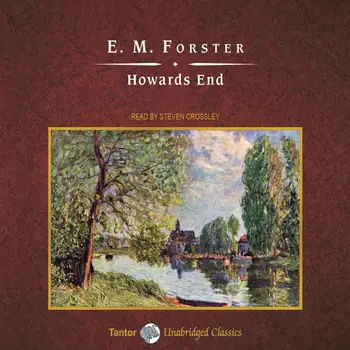
Howards End

Considered by many to be E. M. Forster's greatest novel, Howards End is a beautifully subtle tale of two very different families brought together by an unusual event. The Schlegels are intellectuals, devotees of art and literature. The Wilcoxes are practical and materialistic, leading lives of "telegrams and anger." When the elder Mrs. Wilcox dies and her family discovers she has left their country home—Howards End—to one of the Schlegel sisters, a crisis between the two families is precipitated that takes years to resolve.

Written in 1910, Howards End is a symbolic exploration of the social, economic, and intellectual forces at work in England in the years preceding World War I, a time when vast social changes were occurring. In the Schlegels and the Wilcoxes, Forster perfectly embodies the competing idealism and materialism of the upper classes, while the conflict over the ownership of Howards End represents the struggle for possession of the country's future.

Forster refuses to take sides in this conflict. Instead he poses one of the book's central questions: In a changing modern society, what should be the relation between the inner and outer life, between the world of the intellect and the world of business? Can they ever, as Forster urges, "only connect"?

Über dieses Buch

Considered by many to be E. M. Forster's greatest novel, Howards End is a beautifully subtle tale of two very different families brought together by an unusual event. The Schlegels are intellectuals, devotees of art and literature. The Wilcoxes are practical and materialistic, leading lives of "telegrams and anger." When the elder Mrs. Wilcox dies and her family discovers she has left their country home—Howards End—to one of the Schlegel sisters, a crisis between the two families is precipitated that takes years to resolve.

Written in 1910, Howards End is a symbolic exploration of the social, economic, and intellectual forces at work in England in the years preceding World War I, a time when vast social changes were occurring. In the Schlegels and the Wilcoxes, Forster perfectly embodies the competing idealism and materialism of the upper classes, while the conflict over the ownership of Howards End represents the struggle for possession of the country's future.

Forster refuses to take sides in this conflict. Instead he poses one of the book's central questions: In a changing modern society, what should be the relation between the inner and outer life, between the world of the intellect and the world of business? Can they ever, as Forster urges, "only connect"?
Starte noch heute mit diesem Buch für CHF 0

  • Hole dir während der Testphase vollen Zugriff auf alle Bücher in der App
  • Keine Verpflichtungen, jederzeit kündbar
Jetzt kostenlos testen
Mehr als 52 000 Menschen haben Nextory im App Store und auf Google Play 5 Sterne gegeben.

  1. 16. Okt.

    Howards End

    E. M. Forster

  2. Neu

    En färd till Indien

    E. M. Forster

  3. 11 Tales of the Unknown Before Lovecraft : Early Science Fiction, Weird Tales & Speculative Fiction

    Algernon Blackwood, William Hope Hodgson, E. M. Forster, Ambrose Bierce, Jack London, H.G. Wells, Arthur Machen, Nathaniel Hawthorne

  4. Aspects of the Novel

    E. M. Forster

  5. 3.6

    The Machine Stops

    E. M. Forster

  6. A Room With A View

    E. M. Forster

  7. 3.6

    The Machine Stops :

    E. M. Forster

  8. #186

    The Machine Stops : When Machines Rule: The Cost of Convenience in a Dystopian Society

    E. M. Forster

  9. 50 Vintage Sci-Fi Short Stories 7

    Arthur C. Clarke, Philip K Dick, Ray Bradbury, H.P. Lovecraft, Isaac Asimov, Harlan Ellison, Jack London, Clifford D. Simak, Robert Silverberg, John Wyndham, Frederik Pohl, Fritz Leiber, Fredric Brown, Edmond Hamilton, Murray Leinster, A. Bertram Chandler, Harry Harrison, Robert Sheckley, Hal Clement, Lester del Rey, E. M. Forster, Alan E. Nourse, Chester S Geier, Paul Macnamara, George O. Smith, Murray F. Yaco, Henry Slesar, Frank Lillie Pollock, Morrison Colladay, Herbert D. Kastle, J. F. Bone, Hugh B. Cave, Kenneth Sterling, Charles E. Fritch, Don Mark Lemon, Dick Purcell, Gerda Rhoads, Theodore Sturgeon, Mel Hunter, Ron Cocking, Frank R. Stockton, Dorothy Quick

  10. Lost Sci-Fi Books 181 thru 200 - Twenty Lost Sci-Fi Short Stories from the 1930s, 40s, 50s and 60s

    Isaac Asimov, Philip K Dick, Ray Bradbury, Arthur C. Clarke, Clifford D. Simak, Murray Leinster, Fritz Leiber, E. M. Forster, Hal Clement, Lynn Venable, Fredric Brown, Mack Reynolds, Margaret St. Clair, Gordon R. Dickson, Carl Jacobi, Paul Macnamara, Robert F. Young

  11. Lost Sci-Fi Books 186 thru 190 - Four Lost Vintage Sci-Fi Short Stories from the 1930s, 40s, 50s and 60s and one from 1909

    E. M. Forster, Isaac Asimov, Philip K Dick, Margaret St. Clair, Gordon R. Dickson

  12. Apocalyptic Sci-Fi 3 - 6 Apocalyptic Science Fiction Short Stories : Six Ends of the World, One Chilling Collection

    E. M. Forster, Robert Silverberg, Morrison Colladay, Frank Lillie Pollock, Paul Macnamara, William Brittain