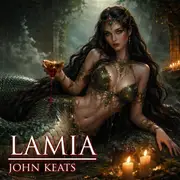
Lamia

Brought to you by Altrusian Grace Media and narrated by Matthew Schmitz.

"Lamia" is the English Romantic poet John Keats's lush, eerie tale of enchantment defeated by merciless rationality. Set in the world of ancient Greco-Roman myth, the poem tells the story of the serpent-spirit Lamia, who talks the god Hermes into transforming her into a beautiful woman so she can pursue her beloved, a handsome young man named Lycius. The couple is blissfully happy for a time—but their joy can't last. Icy reason, in the form of the philosopher Apollonius, at last punctures their shared dream. Often remembered as a Romantic screed against "cold philosophy," this poem is in fact a nuanced and ambivalent portrait of the beauties and dangers of the imagination—especially the imaginative visions of lovers. Keats published this poem in his 1820 collection Lamia, Isabella, the Eve of St. Agnes, and Other Poems.

Über dieses Buch

Brought to you by Altrusian Grace Media and narrated by Matthew Schmitz.

"Lamia" is the English Romantic poet John Keats's lush, eerie tale of enchantment defeated by merciless rationality. Set in the world of ancient Greco-Roman myth, the poem tells the story of the serpent-spirit Lamia, who talks the god Hermes into transforming her into a beautiful woman so she can pursue her beloved, a handsome young man named Lycius. The couple is blissfully happy for a time—but their joy can't last. Icy reason, in the form of the philosopher Apollonius, at last punctures their shared dream. Often remembered as a Romantic screed against "cold philosophy," this poem is in fact a nuanced and ambivalent portrait of the beauties and dangers of the imagination—especially the imaginative visions of lovers. Keats published this poem in his 1820 collection Lamia, Isabella, the Eve of St. Agnes, and Other Poems.
Starte noch heute mit diesem Buch für CHF 0

  • Hole dir während der Testphase vollen Zugriff auf alle Bücher in der App
  • Keine Verpflichtungen, jederzeit kündbar
Jetzt kostenlos testen
Mehr als 52 000 Menschen haben Nextory im App Store und auf Google Play 5 Sterne gegeben.

  1. John Keats: Ode an die Nachtigall : Ausgewählte Gedichte

    John Keats

  2. Lyrikalische Bibliothek

    Heinrich Heine, Annette von Droste-Hülshoff, Charles Baudelaire, John Keats, Rainer Maria Rilke, Georg Heym, Wilhelm Busch, Arno Holz, Johann Wolfgang von Goethe, Christian Morgenstern, Joachim Ringelnatz, Georg Trakl, Ludwig Tieck, Stefan Zweig, Hugo von Hoffmannsthal, Edgar Allan Poe, Frank Wedekind, Franz Werfel, Wolfgang Borchert, Karl Kraus, Kurt Tucholsky, Friedrich Nietzsche, Else Lasker-Schüler, Ludwig Kalisch, Jakob van Hoddis, Joseph von Eichendorff, Gotthold Ephraim Lessing

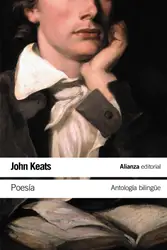
  3. Poesía [Antología bilingüe]

    John Keats

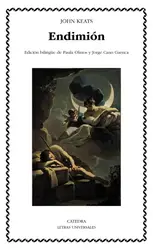
  4. Endimión

    John Keats

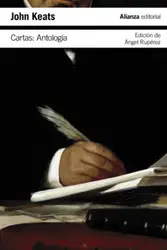
  5. Cartas. Antología

    John Keats

  6. Lyrikalische Lesung Episoden 91-95

    Arno Holz, John Keats, Annette von Droste-Hülshoff, Charles Baudelaire, Rainer Maria Rilke

  7. Lyrikalische Lesung Episoden 76-80

    Christian Morgenstern, Karl Kraus, Wolfgang Borchert, Kurt Tucholsky, Annette von Droste-Hülshoff, John Keats, Rainer Maria Rilke

  8. Lyrikalische Lesung Episoden 66-70

    John Keats, Wilhelm Busch, Ludwig Tieck, Rainer Maria Rilke, Johann Wolfgang von Goethe

  9. Lyrikalische Lesung Episoden 61-65

    Wilhelm Busch, Joachim Ringelnatz, Arno Holz, John Keats, Charles Baudelaire, Annette von Droste-Hülshoff, Else Lasker-Schüler, Georg Heym, Heinrich Heine

  10. Lyrikalische Lesung Episoden 56-60

    Johann Wolfgang von Goethe, John Keats, Annette von Droste-Hülshoff, Arno Holz, Wilhelm Busch, Georg Heym, Heinrich Heine, Franz Werfel, Charles Baudelaire, Rainer Maria Rilke, Friedrich Nietzsche, Hugo von Hofmannsthal, Edgar Allan Poe

  11. Lyrikalische Lesung Episoden 46-50

    Ludwig Kalisch, Else Lasker-Schüler, Annette von Droste-Hülshoff, Edgar Allan Poe, Charles Baudelaire, Hugo von Hoffmannsthal, Arno Holz, John Keats, Heinrich Heine, Karl Kraus, Georg Heym, Joachim Ringelnatz, Ludwig Tieck, Franz Werfel, Kurt Tucholsky, Johann Wolfgang von Goethe, Rainer Maria Rilke, Jakob van Hoddis, Wilhelm Busch