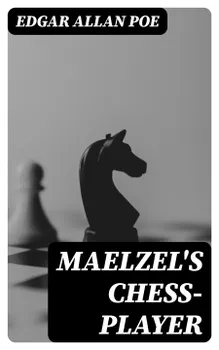
Maelzel's Chess-Player : Enriched edition.

In "Maelzel's Chess-Player," Edgar Allan Poe investigates the intersection of human intellect and mechanized innovation through a compelling narrative that critiques the nature of artificial intelligence and the role of the observer. Written in a style that amalgamates literary realism with philosophical discourse, the text examines a chess automaton designed by Johann Nepomuk Maelzel, revealing deeper themes of illusion, perception, and the boundaries of human cognition. Poe's work is situated in the early 19th century, a time when advances in science and technology provoked profound questions about what it means to think and feel. Edgar Allan Poe, an emblematic figure of American literature and an early pioneer of detective fiction, was profoundly influenced by the philosophical debates of his time regarding free will and determinism. His multifaceted background as a poet, critic, and short story writer infused this essay with a distinctive analytical fervor, driven by his fascination with human psychology and the mechanics of reasoning. The thematic exploration of human agency versus automation in this work reflects Poe's broader inquiries into the nature of reality and illusion. "Maelzel's Chess-Player" is recommended for readers interested in the early explorations of artificial intelligence and the philosophical implications of technology. With its rich prose and thought-provoking content, this work not only showcases Poe's exceptional literary prowess but also invites readers to ponder the critical questions of intellect and existence that resonate through time.

In this enriched edition, we have carefully created added value for your reading experience:

- A succinct Introduction situates the work's timeless appeal and themes.

- The Synopsis outlines the central plot, highlighting key developments without spoiling critical twists.

- A detailed Historical Context immerses you in the era's events and influences that shaped the writing.

- An Author Biography reveals milestones in the author's life, illuminating the personal insights behind the text.

- A thorough Analysis dissects symbols, motifs, and character arcs to unearth underlying meanings.

- Reflection questions prompt you to engage personally with the work's messages, connecting them to modern life.

- Hand‐picked Memorable Quotes shine a spotlight on moments of literary brilliance.

- Interactive footnotes clarify unusual references, historical allusions, and archaic phrases for an effortless, more informed read.

Starten Sie noch heute mit diesem Buch für CHF 0

  • Hol dir während der Probezeit vollen Zugriff auf alle Bücher in der App
  • Keine Verpflichtungen, du kannst jederzeit kündigen
Jetzt kostenlos testen
Mehr als 52 000 Menschen haben Nextory im App Store und auf Google Play 5 Sterne gegeben.

  1. Phantastische Geschichten, Der Untergang des Hauses Usher

    Edgar Allan Poe, Oliver Döring

  2. Halloween Horrorfest – 100 Meisterwerke des Grauens

    Hugh Walpole, H.P. Lovecraft, Mary Shelley, Henry James, Edgar Allan Poe, Jeremias Gotthelf, Washington Irving, Nikolai Gogol, Joseph Sheridan Le Fanu, Bram Stoker, Algernon Blackwood, Fjodor M Dostojewski, Prosper Mérimée, Honoré de Balzac, Robert W. Chambers, Gaston Leroux, Charlotte Perkins Gilman, H.G. Wells, Franz Kafka, Arthur Conan Doyle, Oscar Wilde, Emily Brontë, Octave Mirbeau, Carolyn Wells, Edith Wharton, H. Rider Haggard

  3. 5.0

    100 Klassiker des Horrors: Eine Halloween-Anthologie : Frankenstein, Carmilla, Dracula, Metzengerstein, Der Ruf des Cthulhu, Varney der Vampir, Die Hexe von Salem, Die Phantomkönige...

    Bram Stoker, H.P. Lovecraft, Mary Shelley, Edgar Allan Poe, Ann Radcliffe, Richard Marsh, Algernon Blackwood, Hugh Walpole, H.G. Wells, Emily Brontë, August Strindberg, Heinrich Seidel, Jodocus Temme, Stanislaw Przybyszewski, Felix Salten, H. Rider Haggard, Jane C. Loudon, Edith Wharton, Fjodor M Dostojewski, Wladyslaw Stanislaw Reymont, Marjorie Bowen, Robert W. Chambers, Gaston Leroux, Honoré de Balzac, Robert Louis Stevenson, Charlotte Perkins Gilman, Prosper Mérimée, Henry James

  4. 100 Meisterwerke des Horrors - Klassiker, die man kennen muss : Der Sandmann, Lebendig begraben, Der Vampyr, Frankenstein, Carmilla, Dracula, Die Katzen von Ulthar, Der Käfer, Die Drehung der Schraube

    H.P. Lovecraft, Richard Marsh, E T A Hoffmann, Bram Stoker, Edgar Allan Poe, Mary Shelley, Fjodor M Dostojewski, Hugh Walpole, Franz Kafka, Horace Walpole, Henry James, R. Ryan, James Malcolm Rymer, Prosper Mérimée, Wladyslaw Stanislaw Reymont, Algernon Blackwood, Ann Radcliffe, Marjorie Bowen, Robert W. Chambers, Gaston Leroux, Honoré de Balzac, Robert Louis Stevenson, Charlotte Perkins Gilman, H.G. Wells, Stanislaw Przybyszewski, Arthur Conan Doyle, Oscar Wilde, Octave Mirbeau, Emily Brontë, August Strindberg, Edith Wharton, H. Rider Haggard, Jodocus Temme

  5. Horrorklassiker – Die größten Meisterwerke der Schauerliteratur : Mit Dracula, Carmilla, Frankenstein, Der Schimmelreiter, Jekyll & Hyde, Lovecraft, Poe und mehr

    Bram Stoker, Mary Wollstonecraft Shelley, H.P. Lovecraft, E T A Hoffmann, Edgar Allan Poe, Theodor Storm, Robert Louis Stevenson, Guy De Maupassant, Washington Irving, Joseph Sheridan Le Fanu

  6. Die Meister der klassischen Kriminalliteratur : Mord, Mysterium und Meisterdetektive: Spannende Klassiker von Poe, Doyle, Chesterton & Co.

    Edgar Allan Poe, Jack London, Frédéric Boutet, Richard Harding Davis, Arthur Conan Doyle, Maurice Leblanc, Robert Louis Stevenson, Friedrich Glauser, G.K. Chesterton

  7. 100 Meisterwerke der englischen Literatur - Klassiker, die man kennen muss

    George Orwell, Charles Dickens, Jane Austen, Katherine Mansfield, H.P. Lovecraft, William Wordsworth, John Keats, Percy Bysshe Shelley, Robert Burns, John Milton, William Shakespeare, Christopher Marlowe, Geoffrey Chaucer, Laurence Sterne, Henry Fielding, Mary Shelley, Emily Brontë, Charlotte Brontë, Anne Brontë, William Makepeace Thackeray, George Eliot, D. H. Lawrence, Herman Melville, Thomas Wolfe, Virginia Woolf, Joseph Conrad, Sinclair Lewis, Walt Whitman, Edgar Allan Poe, Oscar Wilde, Jerome K Jerome, Washington Irving, Bram Stoker, H.G. Wells, Daniel Defoe, Lew Wallace, James Fenimore Cooper, Jonathan Swift, Robert Louis Stevenson, Mark Twain, Lewis Carrol, Edward Bulwer-Lytton, F. Scott Fitzgerald, Arthur Conan Doyle, Jack London, Henry David Thoreau, G.K. Chesterton, Edith Wharton, Henry James, Thomas Hardy, Margaret Mitchell, Kate Chopin, Willa Cather, Charlotte Perkins Gilman, James Joyce, John Galsworthy, Francis Hodgson Burnett, Lucy Maud Montgomery, Louisa May Alcott, Rudyard Kipling

  8. Grusel, Horror und Schauer: Die große Hörbuch Box : Klassiker der Weltliteratur

    Robert Louis Stevenson, Nathaniel Hawthorne, E T A Hoffmann, Anton Tschechow, Georg Heym, W. Jacobs, Rudyard Kipling, Guy De Maupassant, H.P. Lovecraft, John Polidori, Edgar Allan Poe, H.G. Wells, Theodor Storm, A. J. Mordtmann

  9. Gruselkabinett, Box 35: Folgen 137, 138, 139, 140

    Robert E. Howard, H.P. Lovecraft, Edgar Allan Poe, M. R. James

  10. Gruselkabinett, Box 32: Folgen 123, 126, 127, 128

    Edgar Allan Poe, H.P. Lovecraft, Charles Dickens, H.G. Wells

  11. Fantasie der Finsternis: Meisterhafte Gruselgeschichten : Dracula, Der Dunwich Horror, Die vier Teufel, Frankenstein, Furchtbare Rache, Die Maske des Roten Todes

    Bram Stoker, Mary Shelley, H.P. Lovecraft, Prosper Mérimée, Edgar Allan Poe, Fjodor M Dostojewski, Nikolai Gogol, Washington Irving, A.K. Tolstoi, Robert Louis Stevenson, John Polidori, Jeremias Gotthelf, H.G. Wells, E. T. Hoffmann, Oscar Wilde, Stanislaw Przybyszewski, Hanns Heinz Ewers, Felix Salten, Herman Bang

  12. Gesammelte Teufelgeschichten: Die Dämonen + Die Elixiere des Teufels + Die schwarze Spinne + Die vier Teufel + Bon-Bon + Das Flaschenteufelchen : Bereicherte Ausgabe.

    Robert Louis Stevenson, Edgar Allan Poe, Herman Bang, Jeremias Gotthelf, E T A Hoffmann, Fjodor Michailowitsch Dostojewski