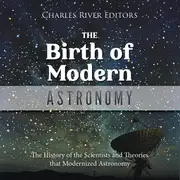
The Birth of Modern Astronomy: The History of the Scientists and Theories that Modernized Astronomy

As interesting as the stories about Tycho Brahe are, chances are he wouldn’t be remembered if not for the important work he did, especially in the realm of astronomy. He lived in an era when the intellectual worldview of most in northern Europe was medieval in nature, influenced mostly by spirituality, mysticism, religion, and metaphysics. Brahe, however, was far-thinking in his outlook, taking advantages of the latest technological ideas and practicing empiricism to revolutionize the field of science. This work eventually led Brahe to cross paths with Johannes Kepler, whose laws on planetary motion would change everything.

Trying to define a man who had the qualities of a mathematician, astronomer, philosopher, inventor, and astrologer can prove difficult. But all of that can be ascribed to Johannes Kepler, one of the giants of his era who ushered in the Scientific Revolution and is often considered the first modern scientist. Kepler stood at a moment in time when the intellectual worldview of most in northern Europe was medieval in nature. Kepler, however, was far-thinking in his outlook.

In his lifetime, Galileo straddled the epochs of the Renaissance and the Scientific Revolution, and it was his work and technological advances that helped usher in a brand new understanding of the solar system and the scientific method. Stephen Hawking himself has asserted, “Galileo, perhaps more than any other single person, was responsible for the birth of modern science." Of course, part of what made Galileo such a monumental figure was the fact that he was ahead of his time, and that he mostly refused to conform to the accepted dogmas of contemporary society.

In 1676, Sir Isaac Newton wrote in a letter, “If I have seen further it is by standing on ye sholders of Giants.” By the time he died, Newton had become science’s greatest giant, and every scientist who has followed him has stood on his shoulders.


Starte noch heute mit diesem Buch für CHF 0

  • Hole dir während der Testphase vollen Zugriff auf alle Bücher in der App
  • Keine Verpflichtungen, jederzeit kündbar
Jetzt kostenlos testen
Mehr als 52 000 Menschen haben Nextory im App Store und auf Google Play 5 Sterne gegeben.

  1. Benito Mussolini and Francisco Franco: The History of Europe’s Other Fascist Dictators

    Charles River Editors

  2. The Rise and Fall of the Third Reich: The History and Legacy of Nazi Germany under Adolf Hitler

    Charles River Editors

  3. Neu

    The Counter-Reformation: The History of the Catholic Church’s Response to the Protestant Reformation

    Charles River Editors

  4. Neu

    The Iranian Revolution and Iran Hostage Crisis: The History of the Events that Broke American Relations with Iran

    Charles River Editors

  5. Neu

    The Age of Sail’s Most Famous Battles: The History of the Naval Engagements that Shaped Europe in the Early Modern Period

    Charles River Editors

  6. Neu

    Persepolis and Susa: The History of the Achaemenid Persian Empire’s Capitals

    Charles River Editors

  7. Neu

    The Christianization of Rome: The History of the Roman Empire’s Religious Conversion

    Charles River Editors

  8. Neu

    Indian Removal: The History of the Battles and Policies that Displaced Native Americans East of the Mississippi River

    Charles River Editors

  9. Neu

    The Dawn of the Age of Exploration: The History of the Initial Expeditions that Led to European Imperialism across the Globe

    Charles River Editors

  10. Neu

    Across the Silk Road and the Atlantic: The History of Marco Polo and Christopher Columbus’ Groundbreaking Voyages

    Charles River Editors

  11. Neu

    The Height of the Cold War: The History of the Events that Brought the Soviet Union and United States to the Brink

    Charles River Editors

  12. Neu

    Kublai Khan and Marco Polo: The History of a Unique Partnership at the Court of the Mongol Empire

    Charles River Editors