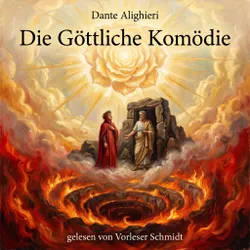
Über dieses Buch

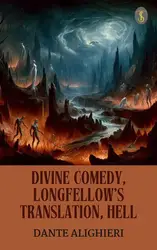
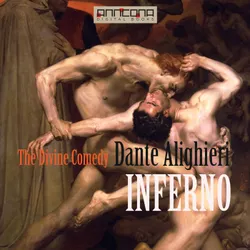
The Divine Comedy is an Italian narrative poem by Dante Alighieri, begun c. 1308 and completed in 1320, a year before his death in 1321. It is widely considered the pre-eminent work in Italian literature and one of the greatest works of world literature. It helped establish the Tuscan language, in which it is written, as the standardized Italian language. It is divided into three parts: Inferno, Purgatorio, and Paradiso.The narrative takes as its literal subject the state of the soul after death and presents an image of divine justice meted out as due punishment or reward, and describes Dante's travels through Hell, Purgatory, and Paradise or Heaven. The poem's imaginative vision of the afterlife is representative of the medieval worldview as it had developed in the Western Church by the 14th century.Allegorically the poem represents the soul's journey towards God, beginning with the recognition and rejection of sin (Inferno), followed by the penitent Christian life (Purgatorio), which is then followed by the soul's ascent to God (Paradiso). Dante draws on medieval Roman Catholic theology and philosophy, especially Thomistic philosophy derived from the Summa Theologica of Thomas Aquinas. Consequently, the Divine Comedy has been called "the Summa in verse". In the poem, the pilgrim Dante is accompanied by three guides: Virgil (who represents human reason, and who guides him for all of Inferno and most of Purgatorio); Beatrice (who represents divine revelation, theology, faith, and grace, guiding him at the end of Purgatorio and for most of Paradiso); and Saint Bernard of Clairvaux (who represents contemplative mysticism and devotion to Mary the Mother, guiding him in the final cantos of Paradiso).
Starte noch heute mit diesem Buch für CHF 0

  • Hole dir während der Testphase vollen Zugriff auf alle Bücher in der App
  • Keine Verpflichtungen, jederzeit kündbar
Jetzt kostenlos testen
Mehr als 52 000 Menschen haben Nextory im App Store und auf Google Play 5 Sterne gegeben.

Mehr von Dante Alighieri

  1. 100 Meisterwerke der Weltliteratur - Klassiker die man kennen muss

    Franz Kafka, Fjodor Michailowitsch Dostojewski, Rumi, Platon, Tacitus, Homer, Sigmund Freud, Friedrich Nietzsche, Oswald Spengler, Alfred Adler, Marcus Aurelius, Arthur Schopenhauer, Walt Whitman, Joseph Conrad, Robert Louis Stevenson, Karl May, Alexandre Dumas, James Fenimore Cooper, Arthur Conan Doyle, Edgar Allan Poe, Mary Shelley, O.Henry, Stefan Zweig, Charles Dickens, Jacob Grimm, Wilhelm Grimm, Hans Christian Andersen, Joseph von Eichendorff, Klaus Mann, Johann Wolfgang Goethe, Jane Austen, Emily Brontë, Charlotte Brontë, Else Lasker-Schüler, Heinrich Heine, Herman Melville, Iwan Sergejewitsch Turgenew, Gustav Freytag, Thomas Wolfe, Jonathan Swift, Walter Scott, Nathaniel Hawthorne, Gustave Flaubert, Rainer Maria Rilke, John Galsworthy, Iwan Alexandrowitsch Gontscharow, Oscar Wilde, Lew Wallace, Voltaire, Lewis Carroll, Johanna Spyri, Mark Twain, Selma Lagerlöf, Rudyard Kipling, Jules Verne, Jack London, Miguel de Cervantes, Honoré de Balzac, Emile Zola, Guy De Maupassant, Moliere, Theodor Fontane, Nikolai Gogol, Leo Tolstoi, Anton Pawlowitsch Tschechow, Dante Alighieri, Joseph Roth, Robert Musil, E. T. Hoffmann, Heinrich Mann, Kurt Tucholsky, Heinrich von Kleist, Annette von Droste-Hülshoff, Gottfried Keller, Sophie von Roche, Theodor Storm, William Shakespeare

  2. 5. Dez.
    #1

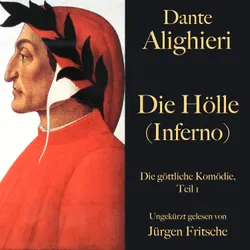
    Dante Alighieri : Die göttliche Komödie, Teil 1. Ungekürzt gelesen von Jürgen Fritsche

    Dante Alighieri

  3. Neu

    La Divina Commedia

    Dante Alighieri

  4. Neu

    100 Clásicos de la Literatura Universal

    Francis Scott Fitzgerald, Mary Shelley, L. Frank Baum, Louisa May Alcott, Dante Alighieri, Jane Austen, Ambrose Bierce, Emily Brontë, Edgar Rice Burroughs, Lewis Carroll, Wilkie Collins, René Descartes, Charles Dickens, Emily Dickinson, Alexandre Dumas, Gustave Flaubert

  5. Neu

    100 Obras Maestras Que Debes Leer Antes De Morir

    F. Scott Fitzgerald, Mary Shelley, L. Frank Baum, Edith Nesbit, Dante Alighieri, Jane Austen, Ambrose Bierce, Emily Brontë, Edgar Rice Burroughs, Lewis Carroll, Wilkie Collins, René Descartes, Charles Dickens, Emily Dickinson, Alexandre Dumas

  6. Neu

    50 Clásicos que debes leer antes de morir

    Dante Alighieri, - Aristoteles, Jane Austen, Charles Baudelaire, Giovanni Boccaccio, Anne Brontë, C. Collodi, James Fenimore Cooper, Fédor Mikhaïlovitch Dostoïevski, Arthur Conan Doyle, Alexandre Dumas, José de Espronceda, Gustave Flaubert, Sigmund Freud, Benito Pérez Galdós, Kahlil Gibran, Johann Wolfgang Goethe, Victor Hugo, Thomas Hardy, Nathaniel Hawthorne, Vicente Blasco Ibáñez, Washington Irving, James Joyce

  7. Neu
    2.4

    The Divine Comedy

    Dante Alighieri

  8. Neu

    Die Göttliche Komödie : Epos in hundert Gesängen

    Dante Alighieri

  9. 2.4

    The Divine Comedy

    Dante Alighieri

  10. The Divine Comedy : Hell, Purgatory and Paradise

    Dante Alighieri

  11. The Divine Comedy : Hell, Purgatory and Paradise

    Dante Alighieri