Über dieses Buch

This audiobook is narrated by an AI Voice.

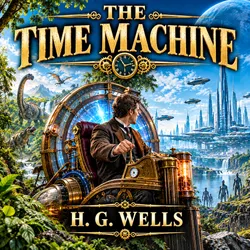
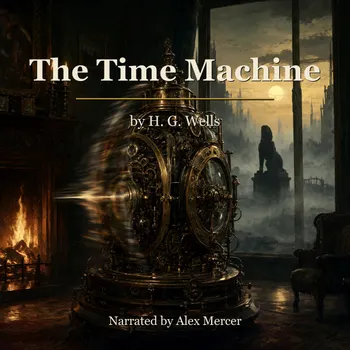
A Victorian gentleman builds a machine of brass, ivory and quartz, sits in the saddle, and pushes the lever. The drawing room dissolves. Outside the window, day and night flicker past like the beating of a wing, and the house crumbles into a garden that becomes a world he does not recognise.

H. G. Wells published The Time Machine in 1895, and it invented most of the rules that time-travel stories have used ever since. It is a short book - you can finish it in an afternoon - but it does three things at once. It is a travel narrative, in which the Traveller explores a distant future the way an explorer might map a new continent. It is a puzzle, in which the reader pieces together what happened to humanity from clues scattered across the landscape. And it is an argument, still unsettling today, about where comfort and ease might lead a species.

What the Traveller finds in the year 802,701 is not a utopia. The Eloi are beautiful, gentle and entirely helpless; the Morlocks are strong, patient and entirely without pity. They are the same species, split by eight hundred thousand years of comfort above ground and labour below. Wells wrote the book in the 1890s, at the height of the class anxieties of industrial England, and its central image - the pretty surface and the machine room underneath - has never stopped being readable.

The prose is plain and fast, with the Traveller telling the story to a circle of sceptical friends by a fire. Wells keeps the science deliberately vague: the point is not the mechanism but where it takes you. The final movement, in which the Traveller goes further than any of the earlier chapters, is among the strangest passages in English fiction.

This unabridged recording uses the complete original 1895 text, including the epilogue. Narrated in a single voice by Alex Mercer.

Starte noch heute mit diesem Buch für CHF 0

  • Hole dir während der Testphase vollen Zugriff auf alle Bücher in der App
  • Keine Verpflichtungen, jederzeit kündbar
Jetzt kostenlos testen
Mehr als 52 000 Menschen haben Nextory im App Store und auf Google Play 5 Sterne gegeben.

Mehr von H.G. Wells

  1. Die Zeitmaschine : Roman

    H.G. Wells

  2. Unheimliches für die dunkle Jahreszeit : Die neue Hörbuch-Playlist für schaurige Stunden

    Edgar Allan Poe, Edward Lytton-Bulwer, Alexander Puschkin, Fjodor Dostojewski, Gustave Flaubert, H.G. Wells, E. T. Hoffmann, Nikolai Gogol, Theodor Storm, Stefan Zweig

  3. 4.7

    Die Insel des Dr. Moreau

    H.G. Wells

  4. Die ersten Menschen auf dem Mond: Science Fiction

    H.G. Wells

  5. 4.4

    Die Zeitmaschine

    H.G. Wells

  6. 100 Meisterwerke des Horrors - Klassiker, die man kennen muss : Gothic-Klassiker, viktorianischer Spuk und kosmische Albträume in einer großen Anthologie

    H.P. Lovecraft, Richard Marsh, E. T. Hoffmann, Bram Stoker, Edgar Allan Poe, Mary Shelley, Fjodor M Dostojewski, Hugh Walpole, Franz Kafka, Horace Walpole, Henry James, R. R. Ryan, James Malcolm Rymer, Prosper Mérimée, Wladyslaw Stanislaw Reymont, Algernon Blackwood, Ann Radcliffe, Marjorie Bowen, Robert W. Chambers, Gaston Leroux, Honoré de Balzac, Robert Louis Stevenson, Charlotte Perkins Gilman, H.G. Wells, Stanislaw Przybyszewski, Arthur Conan Doyle, Oscar Wilde, Octave Mirbeau, Emily Brontë, August Strindberg, Edith Wharton, H. Rider Haggard, Jodocus Temme

  7. 100 Meisterwerke der englischen Literatur - Klassiker, die man kennen muss (Kommentiert) : Erweiterte Ausgabe. Hamlet, 1984, Ulysses...

    George Orwell, Charles Dickens, Jane Austen, Katherine Mansfield, H.P. Lovecraft, William Wordsworth, John Keats, Percy Bysshe Shelley, Robert Burns, John Milton, William Shakespeare, Christopher Marlowe, Geoffrey Chaucer, Laurence Sterne, Henry Fielding, Mary Shelley, Emily Brontë, Charlotte Brontë, Anne Brontë, William Makepeace Thackeray, George Eliot, D. H. Lawrence, Herman Melville, Thomas Wolfe, Virginia Woolf, Joseph Conrad, Sinclair Lewis, Walt Whitman, Edgar Allan Poe, Oscar Wilde, Jerome K Jerome, Washington Irving, Bram Stoker, H.G. Wells, Daniel Defoe, Lew Wallace, James Fenimore Cooper, Jonathan Swift, Robert Louis Stevenson, Mark Twain, Lewis Carrol, Edward Bulwer-Lytton, F. Scott Fitzgerald, Arthur Conan Doyle, Jack London, Henry David Thoreau, G.K. Chesterton, Edith Wharton, Henry James, Thomas Hardy, Margaret Mitchell, Kate Chopin, Willa Cather, Charlotte Perkins Gilman, James Joyce, John Galsworthy, Francis Hodgson Burnett, Lucy Maud Montgomery, Louisa May Alcott, Rudyard Kipling

  8. 3.0

    50 Masterpieces you have to read before you die vol: 1 (2020 Edition) : Included: Little Women, The Richest Man in Babylon Emma, The Call Of The Wild ....

    Louisa May Alcott, Dante Alighieri, Marcus Aurelius, Jane Austen, L. Frank Baum, Charlotte Brontë, Emily Brontë, Anne Brontë, Miguel de Cervantes, Agatha Christie, George S. Clason, Arthur Conan Doyle, Joseph Conrad, Charles Dickens, Fyodor Dostoyevsky, Alexandre Dumas, George Eliot, G.K. Chesterton, G.K. Chesterton, Zane Grey, Nathaniel Hawthorne, Napoleon Hill, Homer, Victor Hugo, Frances Hodgson Burnett, Washington Irving, Henry James, Franz Kafka, Rudyard Kipling, Jack London, Leo Tolstoy, H.P. Lovecraft, Lucy Maud Montgomery, Joseph Murphy, Robert Louis Stevenson, Edgar Allan Poe, Marcel Proust, Publius, Mary Shelley, Bram Stoker, Mark Twain, Sun Tzu, Lew Wallace, Wallace D. Wattles, H.G. Wells

  9. 2.5
    #123

    Gruselkabinett, Folge 123: Die Zeitmaschine

    H.G. Wells

  10. 4.4

    Die Zeitmaschine

    H.G. Wells

  11. 4.7

    Die Insel des Dr. Moreau

    H.G. Wells

  12. 12. Dez.
    4.2
    #6

    The Time Machine

    H.G. Wells