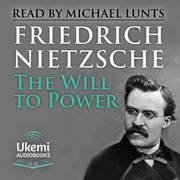
Nietzsche never recovered from his mental breakdown in 1889 and therefore was unable to further any plans he had for the ‘magnum opus’ he had once intended, bringing together in a coherent whole his mature philosophy.
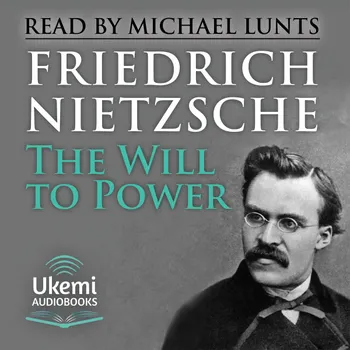
It was left to his close friend Heinrich Köselitz and his sister Elizabeth Förster-Nietzsche to go through the remaining notebooks and unpublished writings, choosing sections of particular interest to produce The Will to Power, giving it the subtitle An Attempted Transvaluation of All Values. It was published in 1901, was expanded in subsequent years and was translated into English in its expanded form in 1910 by Anthony M Ludovici, who had done so much to bring Nietzsche’s work to the English-speaking public.
Ludovici explains that for Nietzsche, the Will to Power was the fundamental principle of all life, a view that could be found in many of his earlier texts, including Thus Spoke Zarathustra: ‘Where there is life, there is also will: not, however, Will to Life, but - so teach I thee - Will to Power!’ (In this, Nietzsche was concerned to overtake Schopenhauer’s concept of the ‘Will to Live’.)
This posthumous compilation is arranged in four books (divided into 1,067 sections):
European Nihilism
A Criticism of the Highest Values That Have Prevailed Hitherto
The Principles of a New Valuation
Discipline and Breeding
Among the themes given prominence by this compilation - and it is, it must be remembered, basically an anthology - are nihilism, metaphysics and the future of Europe.
Nietzsche identified Christianity (and its claim to be ‘higher and better’) and its ‘meek/weak’ attitude as one cause of the nihilism that so concerned him. Another side of the coin was the ineluctable basic human nature of ’the will to power’. Deny that, and nihilism results. But passive nihilism (following the breakdown of social conventions, including conventional religion) can be counteracted by active nihilism and the role of the ‘ubermensch’, the self-reliant.
In aphorism after aphorism he argued for the creation of new values based on acceptance that there is nothing beyond ourselves. It remains his conviction that it is the men who are the masters of themselves - a dominating elite - who must lead. But a deeply human initiative, not the creation of a master race!
Aphorism 22 posits, ‘Nihilism. It may be two things: A. Nihilism as a sign of enhanced spiritual strength: active Nihilism. B. Nihilism as a sign of the collapse and decline of spiritual strength: passive Nihilism.’ Nietzsche’s powerful, uncompromising language continues right to the closing moments, where he concludes, ‘And even you yourselves are this will to power - and nothing besides!’
Translation by Anthony M Ludovici.