Über dieses Buch

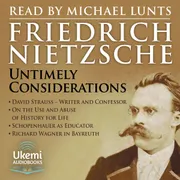
Untimely Considerations contain four essays: 'David Strauss - Writer and Confessor'; 'On the Use and Abuse of History for Life'; 'Schopenhauer as Educator'; and 'Richard Wagner at Bayreuth'.

The essays date from the early part of Nietzsche’s life when his Romantic view on life and art was coloured by the powerful writings and personalities of such figures as Schopenhauer and Wagner - as the titles of two of the essays proclaim. Published between 1873 and 1876, they were presented under the umbrella title 'Unzeitgemässe Betrachtungen', which has been variously translated as 'Thoughts Out Of Season', 'Untimely Meditations', 'Unfashionable Observations' - and 'Untimely Considerations'.

They reflect his early interest particularly in culture, philosophy, and the interplay between art, science and life - topics which he would revisit over the following years. In ‘David Strauss: the Confessor and Writer’, he labels Strauss - a prominent Protestant theologian of the time - as a Philistine, in humorous but derogatory style.

In ‘On the Use and Abuse of History for Life’ Nietzsche sets out to re-examine the role of history in informing contemporary life, and, controversially promotes the importance of individual ‘great men’ rather than the ‘masses’. This theme is continued, in a way, in the third essay, ‘Schopenhauer as Educator’, where he lauds those individual and honest qualities of his philosophic mentor. However, Nietzsche faced more difficulty with the final essay - where he considers both the work and the personality of Wagner - because his own attitudes towards the challenging composer were changing. These four works together present a fascinating portrait of the younger Nietzsche emerging into the highly charged and figure he was to become.

Translations: David Strauss and Richard Wagner - Anthony M Ludovici ; On the Use and Abuse of History for Life - Ian Johnston; Schopenhauer as Educator by Adrian Collins.
Starte noch heute mit diesem Buch für CHF 0

  • Hole dir während der Testphase vollen Zugriff auf alle Bücher in der App
  • Keine Verpflichtungen, jederzeit kündbar
Jetzt kostenlos testen
Mehr als 52 000 Menschen haben Nextory im App Store und auf Google Play 5 Sterne gegeben.

  1. Also sprach Zarathustra (Zweiter Teil)

    Friedrich Nietzsche

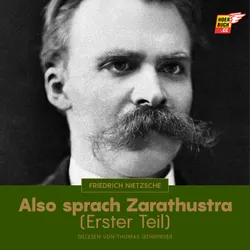
  2. Also sprach Zarathustra (Erster Teil)

    Friedrich Nietzsche

  3. Also sprach Zarathustra

    Friedrich Nietzsche

  4. Also sprach Zarathustra (Dritter Teil)

    Friedrich Nietzsche

  5. Also sprach Zarathustra (Vierter Teil)

    Friedrich Nietzsche

  6. 2.0

    Liebe Liebe, ... : Eine Auseinandersetzung mit der Liebe

    Khalil Gibran, Erich Kästner, Eva Illouz, Virginia Woolf, Adele Schopenhauer, Clara Wieck, Else Lasker-Schüler, Erich Fromm, Franz Grillparzer, Franz Kafka, Friedrich Nietzsche, Friedrich Schiller, G. W. F. Hegel, Gabriele Reuter, Helene Stöcker, Hermann Jaitner, James Krüss, Kathinka Zitz, Mascha Kaléko, Nikolai Gogol, Novalis, Paula Becker, Platon, Rainer Maria Rilke, Ricarda Huch, Sigmund Freud, Ute Richter, Elke Heinrich, Martin Luther, G. Science

  7. Neu

    Ecce homo

    Friedrich Nietzsche

  8. Neu

    The Essential Ancient Wisdom Library : 10 Classics of Philosophy, Strategy and Self-Mastery

    Marcus Aurelius, Seneca, Epictetus, Laozi, Plato, Sun Tzu, Miyamoto Musashi, Niccolò Machiavelli, Friedrich Nietzsche, James Allen

  9. Neu

    The Essential Ancient Wisdom Library : 10 Timeless Classics of Stoicism, Philosophy, Strategy and Self-Mastery

    Marcus Aurelius, Seneca, Epictetus, Laozi, Plato, Sun Tzu, Miyamoto Musashi, Niccolò Machiavelli, Friedrich Nietzsche, James Allen

  10. Neu

    The Essential Ancient Wisdom Library : 10 Timeless Classics of Stoicism, Philosophy, Strategy and Self-Mastery

    Marcus Aurelius, Seneca, Epictetus, Laozi, Plato, Sun Tzu, Miyamoto Musashi, Niccolò Machiavelli, Friedrich Nietzsche, James Allen

  11. Neu
    3.5

    Beyond Good and Evil

    Friedrich Nietzsche

  12. Ausgewählte Briefe. Ein Grundlagenwerk der Philosophie. : Hörbuchzeit: Klassiker der Weltliteratur

    Hörbuchzeit, Friedrich Nietzsche