Über dieses Buch

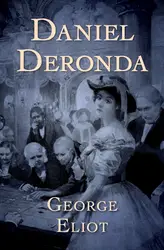
Daniel Deronda , published in 1876, was George Eliot's last novel. It deals with two major characters whose lives intersect: One is a spoiled young woman named Gwendolen Harleth who makes an unwise marriage to escape impending poverty; the other is the titular character, Daniel Deronda, a wealthy young man who feels a mission to help the suffering. During her childhood Gwendolen's family was well-off. She lived in comfort and was indulged and pampered. But the family's fortune is lost through an unwise investment, and she returns to a life of near-poverty, a change which she greatly resents both for herself and for her widowed mother. The only escape seems to be for her to marry a wealthy older man who has been courting her in a casual, unemotional way. The marriage turns out to be a terrible mistake. Daniel Deronda has been raised by Sir Hugo Mallinger as his nephew, but Daniel has never discovered his true parentage, thinking it likely that he is Sir Hugo's natural son. This consciousness of his probable illegitimacy moves him to kindness and tolerance towards anyone who is suffering from disadvantage. One evening, while rowing on the river Thames, he spots a young woman about to leap into the water to drown herself. He persuades her instead to come with him for shelter to a family he knows. The young woman turns out to be Jewish, and through his trying to help her find her lost family, Deronda comes into contact with Jewish culture—and in particular with a man named Mordecai, who has a passionate vision for the future of the Jewish race and who sees in Daniel a kindred spirit. The paths that Gwendolen and Daniel follow intersect often, and Daniel's kindly nature moves him to try to offer her comfort and advice in her moments of distress. Unsurprisingly, Gwendolen misinterprets Daniel's attentions. In Daniel Deronda Eliot demonstrates considerable sympathy towards the Jewish people, their culture, and their aspirations for a national homeland. At the time this was an unpopular and even.
Starte noch heute mit diesem Buch für CHF 0

  • Hole dir während der Testphase vollen Zugriff auf alle Bücher in der App
  • Keine Verpflichtungen, jederzeit kündbar
Jetzt kostenlos testen
Mehr als 52 000 Menschen haben Nextory im App Store und auf Google Play 5 Sterne gegeben.

Mehr von George Eliot

  1. 50 Masterpieces you have to read before you die vol: 1

    Louisa May Alcott, Jane Austen, Joseph Conrad, D. H. Lawrence, George Eliot, Leo Tolstoy, James Joyce, Charles Dickens, Bram Stoker, Oscar Wilde, Honoré de Balzac, Edgar Rice Burroughs, Anne Brontë, Charlotte Brontë, Emily Brontë, Lewis Carroll, Willa Cather, Miguel de Cervantes, E. E. Cummings, Fyodor Dostoyevsky, Daniel Defoe, Arthur Conan Doyle, Alexandre Dumas, Gustave Flaubert, Henry James, Victor Hugo

  2. Die größten Heldinnen der Literatur (50 Romane in einem Band) : 50 Romane über weibliche Selbstbehauptung, Bildung und gesellschaftliche Grenzen

    Charlotte Brontë, Jane Austen, Louisa May Alcott, Leo Tolstoi, Virginia Woolf, Thomas Hardy, Sinclair Lewis, Hedwig Dohm, Charlotte Perkins Gilman, Elizabeth Burgoyne Corbett, Daniel Defoe, Anne Brontë, L.M. Montgomery, Victor Hugo, Wilhelmine von Hillern, Adalbert Stifter, Luise Ahlborn, George Eliot, Lou Andreas-Salomé, Stefan Zweig, D. H. Lawrence, Henry James, Margaret Mitchell, Edith Wharton, Miles Franklin, Willa Cather, Elizabeth Gaskell, Nikolai Semjonowitsch Leskow, Theodore Dreiser, Elizabeth von Arnim, Colette, Honoré de Balzac, William Makepeace Thackeray, Gustave Flaubert, Emile Zola, Theodor Fontane, Ada Langworthy Collier, Joseph Sheridan Fanu, Johanna Schopenhauer, Nathaniel Hawthorne, Charles Dickens

  3. 50 Klassiker des Feminismus - Bücher, die man kennen muss : Schlüsseltexte zu Frauenbildung, Ehekritik und Selbstbestimmung

    Kate Chopin, Charlotte Perkins Gilman, Virginia Woolf, Charlotte Brontë, George Sand, Louisa May Alcott, Jane Austen, L.M. Montgomery, Victor Hugo, Daniel Defoe, Nathaniel Hawthorne, Wilhelmine von Hillern, Adalbert Stifter, Luise Ahlborn, George Eliot, Lou Andreas-Salomé, D. H. Lawrence, Henry James, Margaret Mitchell, Edith Wharton, Miles Franklin, Willa Cather, Leo Tolstoi, Henrik Ibsen, Elizabeth Gaskell, Nikolai Semjonowitsch Leskow, Theodore Dreiser, Elizabeth von Arnim, Colette, Emmeline Pankhurst, Louise Aston, Bertha von Suttner, Hedwig Dohm, Mary Wollstonecraft, Elizabeth Cady Stanton, Matilda Joslyn Gage, John Stuart Mill, Thomas Hardy, Sinclair Lewis, Elizabeth Burgoyne Corbett, Anne Brontë

  4. 5. Nov.
    4.8

    Middlemarch

    George Eliot

  5. Neu
    4.3

    Silas Marner

    George Eliot

  6. Bestbewertet
    4.8

    Middlemarch

    George Eliot

  7. Bestbewertet
    4.8

    Middlemarch

    George Eliot

  8. Neu

    Middlemarch : A Study of Provincial Life

    George Eliot

  9. Neu

    Middlemarch : A Study of Provincial Life

    George Eliot

  10. Neu

    Scenes of Clerical Life : Three Tales of a Midland Parish

    George Eliot

  11. Neu

    The Mill on the Floss : A Brother, a Sister and the River

    George Eliot

  12. Neu

    Felix Holt, the Radical : An English Election and a Disputed Estate

    George Eliot